
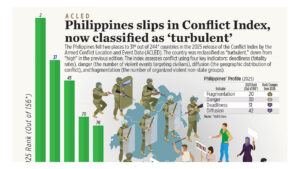
ACLED Conflict Index Philippines data highlights how conflict trends can affect stability, risk exposure, and long-term business resilience.
In today’s economic environment, competitiveness is no longer defined only by productivity, innovation, and market access. Stability and risk conditions increasingly shape how investors, employers, and supply chains make decisions. One of the global references used to measure these conditions is the Conflict Index published by the Armed Conflict Location and Event Data (ACLED), which tracks conflict patterns across countries using standardized indicators.
In the 2025 release of the ACLED Conflict Index, the Philippines was ranked 31st out of 244 countries and reclassified as “turbulent,” shifting from the previous classification of “high.” While headlines can easily trigger concern, it is important to understand what this index measures and why this type of data matters beyond politics and security discussions. For business owners, workforce planners, and local communities, conflict indicators can influence everything from expansion decisions to operational continuity.
What the Conflict Index is actually measuring
ACLED’s index does not rely on broad perceptions or general sentiment. It evaluates conflict exposure through measurable patterns such as the frequency, spread, and targeting of violent incidents. The goal is to translate complex security events into trackable indicators that can be compared over time and across geographies.
The index uses four major indicators that provide a structured picture of conflict conditions.
First is deadliness, which focuses on fatality rates. This reflects the severity of violence and how lethal events are in a given environment. Second is danger, which looks at violent incidents that target civilians. This is a key component because the safety of communities strongly affects labor mobility, market activity, and consumer confidence. Third is diffusion, which measures how geographically spread out conflict is. A conflict that is contained in a limited area has a different impact than conflict that spreads across multiple regions. Fourth is fragmentation, which refers to the number of organized violent non-state groups involved, indicating how complex and multi-actor conflict dynamics are.
These four indicators help move the discussion away from generalizations and toward a more practical assessment of risk environments.
Why businesses should pay attention to conflict indicators
Even when a business is not directly operating in conflict-affected areas, the broader economy can still feel the effects through logistics disruptions, investor sentiment, and shifts in labor availability. Conflict conditions can lead to higher operating costs because companies may need stronger security protocols, alternative supply routes, or additional contingency plans. It can also affect hiring and retention, particularly if employees must travel between regions or if remote work becomes necessary for safety.
For SMEs, the impact may be more indirect but still important. Uncertainty affects purchasing behavior, demand cycles, and financing conditions. In some cases, it can slow down local commerce, limit foot traffic for physical businesses, or reduce participation in certain markets. For larger organizations or firms planning to scale, risk indexes can shape decisions on where to expand, where to place key teams, and how to structure continuity planning.
What “turbulent” should mean in practical terms
A classification like “turbulent” should not be interpreted as a prediction of economic decline. Instead, it should be treated as a signal that risk factors are present and should be actively managed. It is a reminder to strengthen resilience in business systems and local governance—not to assume the worst, but to prepare intelligently.
For business leaders, the most productive response is not fear. The productive response is planning. This can include reviewing operational dependencies, identifying which processes are most vulnerable to disruptions, and ensuring teams have clear continuity protocols. It also means improving data monitoring so leadership teams can respond early rather than late.
A resilience-first approach for Philippine competitiveness
The long-term goal is national competitiveness that is sustainable. That competitiveness depends not only on growth initiatives but also on stability and capacity to absorb shocks. When businesses, communities, and institutions improve readiness, the economy becomes more investable, more reliable, and stronger in the face of uncertainty.
In the DTI Negosyo perspective, understanding risk indices like ACLED’s is not about reacting emotionally to rankings. It is about developing a culture of preparedness. The more businesses treat risk management as a core function—alongside marketing, operations, and finance—the more resilient and scalable they become.
Stability is not only a public sector responsibility. It also becomes a strategic business advantage when organizations plan, adapt, and build systems that can operate even in changing conditions.
Leave a Reply