
Philippines Asia Manufacturing Ranking: Key Areas for Competitiveness Improvement
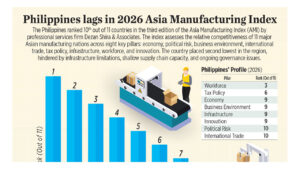
The Philippines Asia manufacturing ranking in 2026 highlights the country’s position in the Asia Manufacturing Index (AMI) and its competitiveness as a manufacturing destination in the region. The index is intended to help stakeholders understand the business conditions that influence manufacturing investment, industrial expansion, and supply chain readiness across the region.
In the latest results, the Philippines ranked near the lower end among the economies included in the study. While this position reflects the need for continued competitiveness reforms, it should be understood as a reference point for strategic improvement rather than a limitation of national potential. The country remains positioned to grow its manufacturing sector by strengthening key enabling conditions that support productivity, resilience, and investment confidence. The Philippines Asia manufacturing ranking provides an important benchmark for identifying priority areas that affect manufacturing performance and supply chain readiness.
What the Index Measures and Why It Matters
The AMI uses a multi-factor approach in assessing each economy. It does not focus solely on output levels or labor cost; rather, it evaluates broader conditions that allow manufacturing to operate efficiently and sustainably. These include economic stability, political risk, business environment, trade systems, taxation, infrastructure capacity, workforce readiness, and innovation capability.
For manufacturing enterprises, these indicators are important because they directly impact operational predictability. A competitive manufacturing location is one where production can be maintained with minimal disruption, goods can move efficiently through ports and logistics networks, and supply chains can be supported through a reliable base of local suppliers and service providers.
Key Takeaways for Philippine Manufacturing
The Philippines’ lower ranking points to areas where industry conditions can be improved to reduce cost pressures and enhance investor confidence. These factors commonly relate to infrastructure adequacy, logistics performance, regulatory predictability, and the availability of strong support from supply chain industries.
It is important to emphasize that manufacturing competitiveness is no longer defined only by cost advantages. Manufacturing today is shaped by the ability of countries and enterprises to meet global requirements on quality standards, delivery reliability, traceability, and production scaling. In this context, overall readiness depends on both national systems and firm-level capacity to modernize operations and comply with market standards.
Advisory for MSMEs and Local Manufacturers
Local manufacturers, including MSMEs participating in industrial supply chains, are strongly encouraged to treat the index as an educational benchmark. The findings reinforce the need for enterprises to upgrade processes, pursue quality and compliance improvements, and adopt productivity-enhancing technologies.
As regional manufacturing competition increases, businesses that align with higher operational standards are more likely to secure partnerships in larger supply chains. This includes readiness for export requirements, stronger documentation and inventory controls, improved production planning, and consistent product quality. Businesses that invest early in these areas are better positioned to benefit from expanding demand and broader market opportunities.
Strategic Direction Moving Forward
The index results underscore the continuing importance of strengthening enabling environments for manufacturing. This includes improvements in logistics efficiency, infrastructure reliability, industry support systems, and innovation readiness. It also highlights the value of collaborative efforts between the public and private sectors in accelerating modernization across the manufacturing ecosystem.
For enterprises, the key message is clear. Building competitiveness requires continuous improvement at the firm level, particularly in operational efficiency, workforce skills development, and technology adoption. Strengthening these areas helps enterprises remain viable, scalable, and attractive to supply chain integration both locally and internationally.
Disclaimer
This article is independently written and is intended to complement publicly available information. For official DTI policies and advisories, please refer to official government channels.
Leave a Reply