
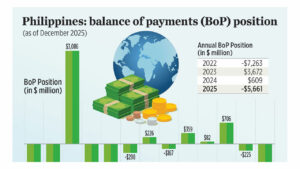
What Drives the Philippines BoP Deficit
The Philippines BoP deficit widened in 2025 as the country’s overall external position shifted from surplus to a full-year shortfall, reflecting pressures from trade and cross-border financial flows. Data from the Bangko Sentral ng Pilipinas (BSP) showed that foreign currency outflows exceeded inflows during the year. Data released by the Bangko Sentral ng Pilipinas (BSP) showed that the overall balance of payments (BoP) position recorded a deficit for the year. Data released by the Bangko Sentral ng Pilipinas (BSP) showed that the overall balance of payments (BoP) position recorded a deficit for the year, reversing the outcome posted in 2024. Analysts said the Philippines BoP deficit reflects shifting trade and financial flows during the year.
The balance of payments is a key measure of a country’s transactions with the rest of the world, including trade in goods and services, investment flows, and other cross-border payments. A deficit generally indicates that more foreign currency flowed out than came in during a given period, while a surplus signals net inflows.
For 2025, the BSP reported a $5.661-billion BoP deficit, a turnaround from the $609-million surplus in 2024. The full-year result was also narrower than the central bank’s earlier projection of a $6.2-billion gap.
Philippines Balance of Payments Deficit: Key 2025 Figures
December deficit narrows year-on-year
In December alone, the Philippines posted a BoP deficit of $827 million. While this was smaller compared with the $1.508-billion deficit recorded in December 2024, it was wider than the $225-million shortfall in November 2025, indicating month-to-month volatility in external flows.
Why the BoP matters
Economists and businesses closely monitor the BoP because it provides insights into the country’s demand for foreign currency and the strength of external accounts. It can influence market sentiment, exchange rate expectations, and the wider outlook for trade-dependent sectors.
A widening deficit may increase attention on import demand, export competitiveness, tourism receipts, and foreign investment levels. At the same time, deficits can still be manageable depending on the size of international reserves and the country’s ability to finance external gaps.
What Drives a Balance of Payments Deficit
The BoP outcome is affected by a combination of factors, including the trade balance, foreign investments, remittances, and financial market conditions. When imports expand faster than exports, the trade balance can worsen and contribute to increased foreign currency outflows.
The BSP noted that the trade-in-goods deficit (exports minus imports) narrowed to $45.2 billion as of end-November 2025, improving from $50.18 billion in the same period in 2024, suggesting some easing in the trade gap.
However, even with improvements in parts of the trade balance, shifts in investment flows and other external payments can still push the overall BoP position into deficit.
Areas Affected / Advisory
While the BoP is a national-level economic indicator, a Philippines balance of payments deficit may influence several groups and sectors that rely on foreign currency movements and external financing. Key areas to watch include:
-
Import-dependent businesses, especially those buying raw materials and finished goods abroad
-
Exporters and global service providers, including firms that earn in US dollars
-
Overseas Filipino remittance-linked households, where exchange rate shifts affect the peso value
-
Tourism and travel-related industries are influenced by foreign exchange conditions
-
Investors and borrowers, particularly those exposed to foreign-currency debt or funding
Outlook as External Conditions Remain Dynamic
Looking ahead, the BSP expects the overall BoP position to remain in deficit in 2026, with an estimated $5.9-billion gap (around -1.2% of GDP), suggesting that external account pressures may continue even as the country manages trade and investment conditions.
Despite the deficit position, the BSP reported that the country’s gross international reserves rose to $110.833 billion as of end-2025, higher than the previous year’s $106.257 billion. Strong reserves are often viewed as a buffer against external shocks and can support overall financial stability. The wider Philippines BoP deficit highlights the importance of monitoring import demand and capital movement.
What the Public Should Do
For the general public, BoP developments do not immediately change daily life, but they can affect broader economic conditions over time, particularly through possible influence on foreign exchange trends. Consumers and business owners may benefit from monitoring credible economic updates and planning conservatively when dealing with foreign-currency exposures.
For small businesses and households, practical actions may include managing budgets carefully, reviewing prices of imported goods, and strengthening savings strategies during periods of shifting market conditions. For companies with import requirements or international payments, risk management measures such as adjusting purchasing cycles and negotiating payment terms can help reduce exposure to exchange rate volatility.
Disclaimer
This article is intended for general informational purposes only and is news-inspired based on publicly available reporting. It does not constitute financial, investment, or legal advice. For official data and statements, readers are encouraged to refer to releases from the Bangko Sentral ng Pilipinas (BSP) and other authorized government sources.
Leave a Reply