
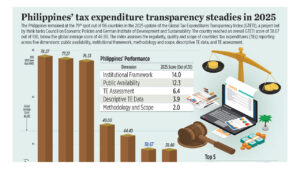
The Philippines tax expenditure transparency remains a key indicator of how clearly the government reports and evaluates tax incentives such as exemptions, deductions, credits, and preferential tax treatments that reduce public revenue. In the 2025 update of the Global Tax Expenditures Transparency Index (GTETI), the Philippines maintained its position at 79th out of 116 countries. The index, developed by the Council on Economic Policies and the German Institute of Development and Sustainability, evaluates how governments disclose and assess tax expenditures, including exemptions, deductions, credits, and preferential tax treatments that reduce public revenue.
The country’s standing in the latest GTETI release draws renewed attention to an important governance issue: the Philippines tax expenditure transparency. In a period where fiscal sustainability, public accountability, and policy credibility matter more than ever, transparency in tax incentives is becoming a critical foundation for stronger economic planning and improved public trust.
In the 2025 index update, the Philippines recorded an overall GTETI score of 38.67 out of 100, falling below the global average score of 46.90. This gap suggests that while tax expenditure reporting exists in some form, there is still significant room to strengthen national practices. Enhancing disclosure quality, improving reporting consistency, and refining institutional accountability mechanisms can help the country align better with international standards for fiscal transparency.
The GTETI assesses tax expenditure reporting across five key dimensions: public availability of reports, institutional framework, methodology and scope, descriptive tax expenditure data, and tax expenditure assessment. Together, these dimensions provide a comprehensive view of how well a government tracks and reports the cost and impact of incentives. Improving performance across these areas can reinforce the credibility of fiscal policymaking and support more evidence-based public finance management.
The importance of the Philippines’ tax expenditure transparency extends far beyond compliance or reporting. Tax incentives shape investment decisions, influence business behavior, and affect overall government revenue. For entrepreneurs and business owners, incentives can determine the viability of expansions, job creation plans, and long-term capital investments. For taxpayers, incentives can raise questions about fairness and efficiency, especially when benefits appear concentrated in certain sectors or entities. For investors, transparent fiscal reporting signals stability and reduces the perception of governance risk.
Transparency also strengthens policy evaluation. When tax expenditure reports clearly identify incentives, estimate their revenue impact, and assess their effectiveness, policymakers are better equipped to determine which programs deliver measurable economic value and which may be underperforming. Without consistent disclosure, incentives can remain in place for years without sufficient review, potentially weakening government capacity to fund essential public services and development priorities.
As the Philippines continues implementing fiscal reforms amid evolving economic conditions, improving the transparency of tax expenditures becomes increasingly relevant. Stronger transparency practices help reduce uncertainty, enhance institutional trust, and improve long-term planning. In turn, this supports a more sustainable fiscal environment where incentives are aligned with national development goals, measurable outcomes, and responsible governance.
Ultimately, strengthening the Philippines’ tax expenditure transparency is not only about publishing figures. It is about improving the quality of decision-making, enhancing accountability, ensuring policy alignment, and building confidence among all stakeholders. Continued improvements in disclosure and assessment standards can serve as a strategic step toward stronger economic governance and more resilient national growth.
Source: BusinessWorld Online (Infographics), January 15, 2026.
Leave a Reply