
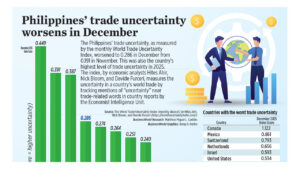
Philippines Trade Uncertainty: What the Index Measures
Philippines trade uncertainty increased in December, highlighting heightened concerns around global trade conditions that may affect imports, supply chains, and MSME planning. This indicator reflects heightened uncertainty surrounding global trade conditions and trade-related risks, which can influence market behavior, supply chain decisions, and business confidence. Trade uncertainty is an important measure because it affects how companies plan production, sourcing, pricing, and investment. When uncertainty increases, businesses often take a more cautious approach, including delaying expansion decisions, reassessing procurement schedules, and strengthening contingency plans for supply disruptions and cost fluctuations.
What the World Trade Uncertainty Index Measures
The WTUI is a global index designed to track uncertainty linked to world trade. It is based on the frequency of trade-related uncertainty mentions within country reports of the Economist Intelligence Unit. By monitoring these references, the index helps provide an additional data point on how trade conditions may be perceived globally and domestically. A higher index level generally suggests that trade-related risks and concerns are becoming more prominent, particularly due to factors such as global economic shifts, trade policy changes, geopolitical developments, and supply chain disruption risks.
Why Trade Uncertainty Matters for Local Enterprises
For MSMEs and local enterprises, trade uncertainty is not only a global issue—it can translate into practical business challenges. Many local businesses depend on imported raw materials, packaging, parts, fuel-related inputs, and equipment. When trade uncertainty rises, it may lead to changes in shipping costs, longer delivery lead times, or price volatility from suppliers. Philippines trade uncertainty can influence supplier pricing, shipping lead times, and currency-related costs for import-reliant enterprises.
In addition, trade uncertainty can influence currency movement and market sentiment, which can further affect pricing and overall cost planning. This is particularly important for businesses engaged in importation, export operations, or those that serve industries tied to international demand, such as manufacturing, electronics, consumer goods, and agri-based processing.
Advisory for MSMEs: Practical Preparedness Measures
Given the possibility of short-term volatility and shifting trade conditions, enterprises are encouraged to strengthen operational preparedness through proactive planning. This may include reviewing procurement and inventory policies, maintaining cost buffers for critical imported inputs, strengthening supplier diversification, and updating pricing strategies where appropriate.
Businesses with export exposure may also consider reinforcing customer communication and order planning, especially where overseas demand is sensitive to global uncertainty. At the enterprise level, preparedness often depends on the ability to anticipate disruptions and maintain continuity even as external conditions shift.
Moving Forward
Trade uncertainty is a reminder that local businesses operate within a global environment where policy decisions and market shifts can influence costs and demand. While uncertainty indicators do not directly predict outcomes, they highlight the need for resilience and better risk management at the enterprise level.
Strengthening supply chain discipline, improving cash flow visibility, and maintaining operational flexibility can support MSMEs in adapting to uncertain trade conditions and protecting business sustainability.
Disclaimer
This content is independently prepared for general informational purposes. It is not affiliated with or endorsed by the Department of Trade and Industry (DTI) and should not be treated as an official government policy or advisory.
Leave a Reply